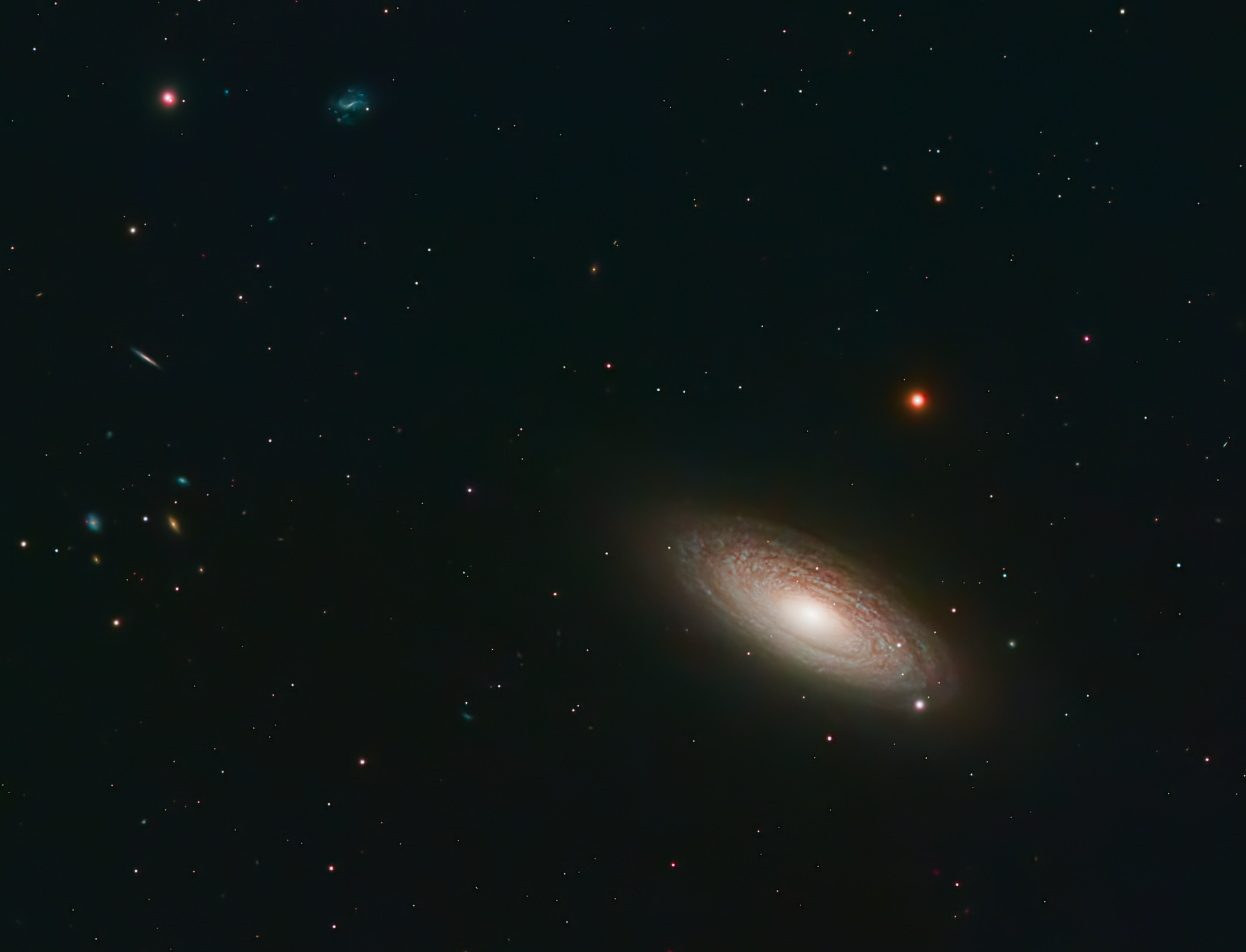
NGC 2841

Full Size Images:

Wikipedia Description:

NGC 2841 is an unbarred spiral galaxy in the northern circumpolar constellation of Ursa Major. It was discovered on 9 March, 1788 by German-born astronomer William Herschel. J. L. E. Dreyer, the author of the New General Catalogue, described it as, “very bright, large, very much extended 151°, very suddenly much brighter middle equal to 10th magnitude star”.[7] Initially thought to be about 30 million light-years distant, a 2001 Hubble Space Telescope survey of the galaxy’s Cepheid variables determined its distance to be approximately 14.1 megaparsecs or 46 million light-years.[4] The optical size of the galaxy is 8.1′ × 3.5′.[6]

This is the prototype for the flocculent spiral galaxy,[5] a type of spiral galaxy whose arms are patchy and discontinuous.[8] The morphological class is SAa, indicating a spiral galaxy with no central bar and very tightly-wound arms. There is no grand design structure visible in the optical band, although some inner spiral arms can be seen in the near infrared.[5] It is inclined by an angle of 68° to the line of sight from the Earth, with the major axis aligned along a position angle of 148°.[5]

The properties of NGC 2841 are similar to those of the Andromeda Galaxy.[4] It is home to a large population of young blue stars, and a few H II regions.[9] The luminosity of the galaxy is 2×10¹⁰ L and it has a combined mass of 7×10¹⁰ M.[6] Its disk of stars can be traced out to a radius of around 228 kly (70 kpc). This disk begins to warp at a radius of around 98 kly (30 kpc), suggesting the perturbing effect of in-falling matter from the surrounding medium.[5]

Wikipedia: NGC 2841

Acquisition Details:

TelescopeTakahashi TOA-130
OpticsTakahashi TOA-645 Flattener
FilterNone
CameraASI2600MC Pro OSC
Integration Time5.7 Hours
Subframes171 x 120 Seconds
DateJanuary 30, 2025
LocationCarlsbad, California