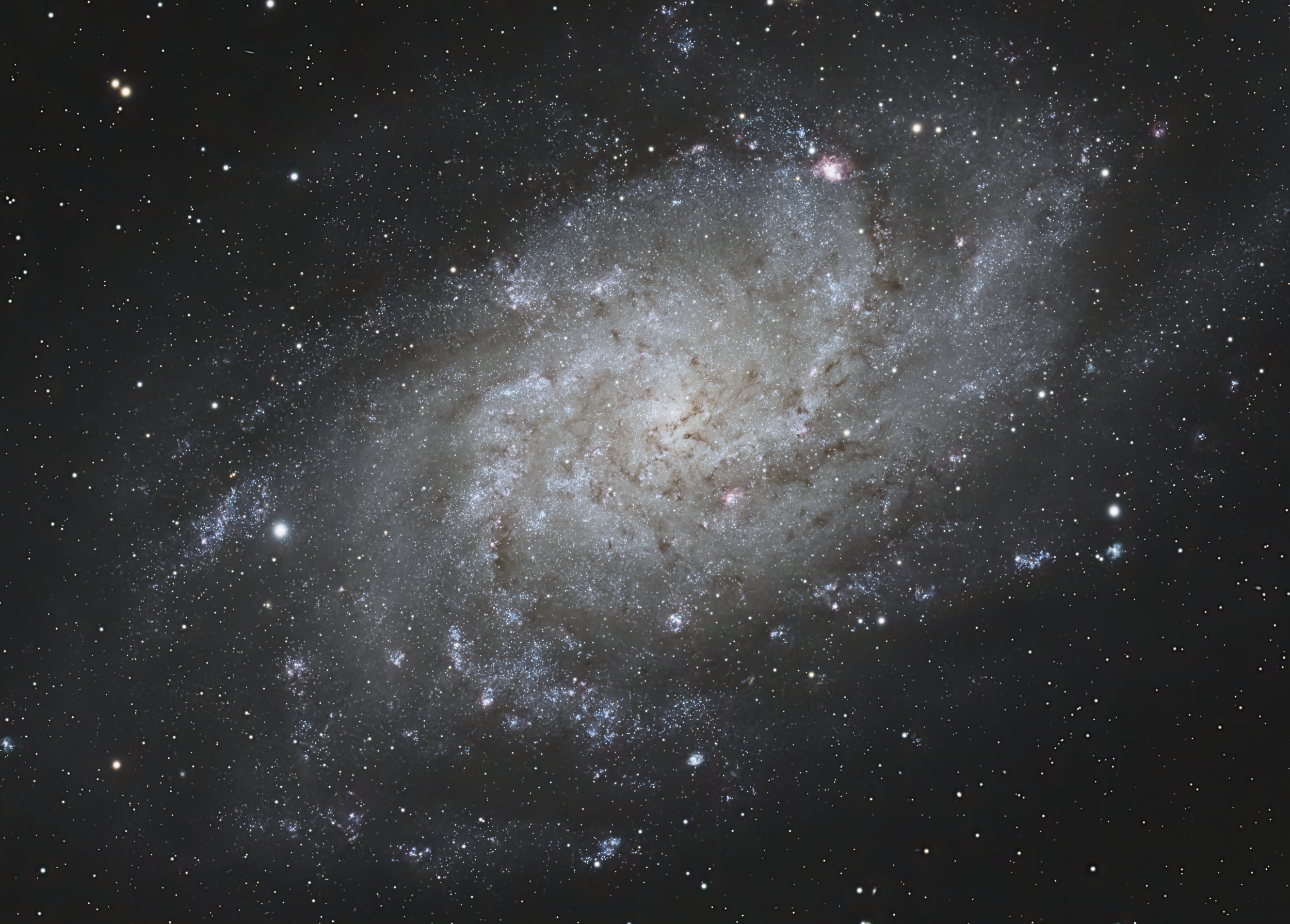
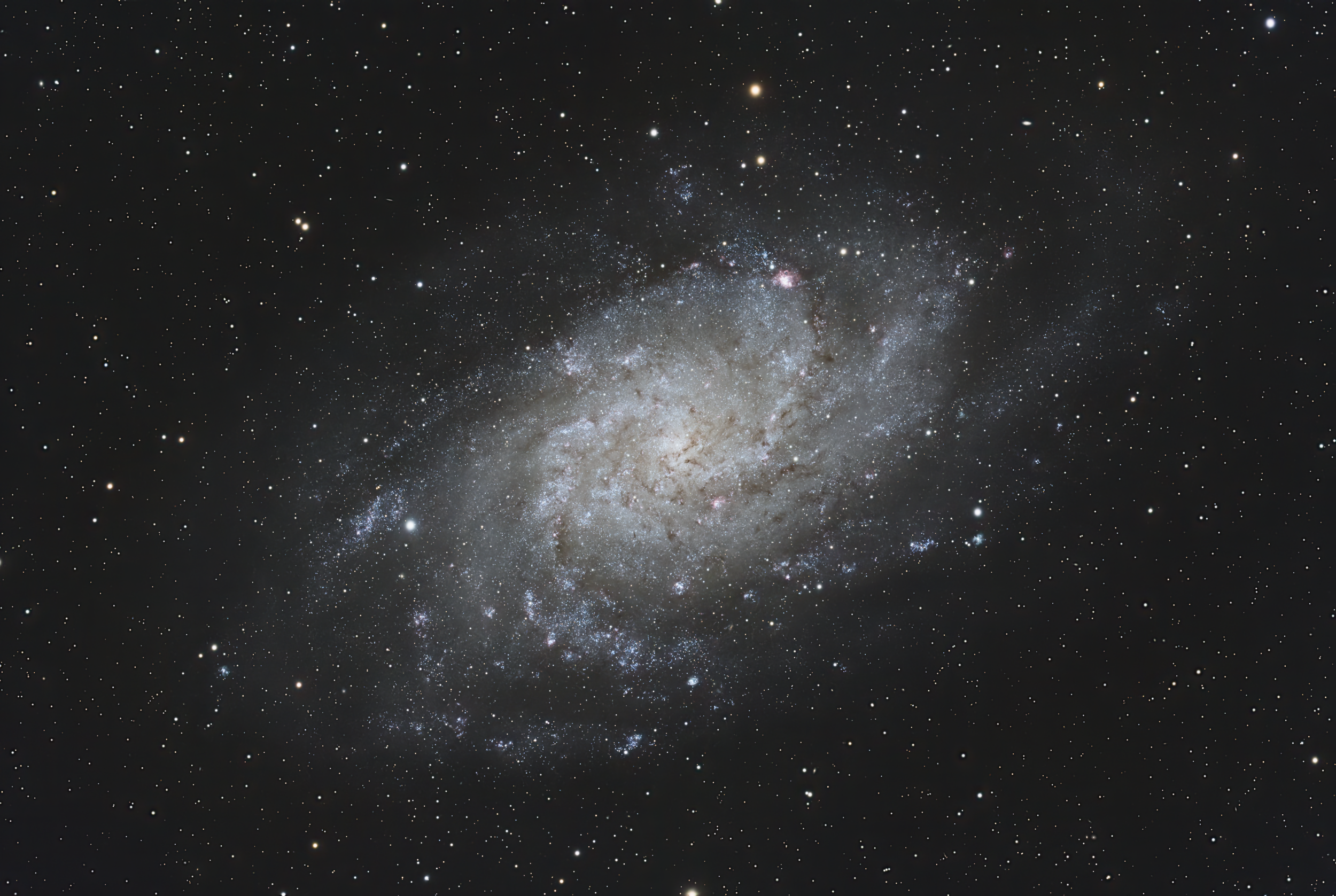
Wikipedia Description:
The Triangulum Galaxy is a spiral galaxy 2.73 million light-years (ly) from Earth in the constellation Triangulum. It is catalogued as Messier 33 or NGC 598. With the D25 isophotal diameter of 18.74 kiloparsecs (61,100 light-years), the Triangulum Galaxy is the third-largest member of the Local Group of galaxies, behind the Andromeda Galaxy and the Milky Way.
The galaxy is the second-smallest spiral galaxy in the Local Group after the Large Magellanic Cloud, which is a Magellanic-type spiral galaxy.[8] It is believed to be a satellite of the Andromeda Galaxy or on its rebound into the latter due to their interactions, velocities,[9] and proximity to one another in the night sky. It also has an H II nucleus.[10]
The galaxy gets its name from the constellation Triangulum, where it can be spotted.
It is sometimes informally referred to as the “Pinwheel Galaxy” by some astronomy references,[11] in some computerized telescope software, and in some public outreach websites.[12] However, the SIMBAD Astronomical Database, a professional database, collates formal designations for astronomical objects and indicates that Pinwheel Galaxy refers to Messier 101,[13] which several amateur astronomy resources including public outreach websites identify by that name, and that is within the bounds of Ursa Major.[14]
Acquisition Details:
| Telescope | Takahashi TOA-130 |
| Optics | Takahashi TOA-645 Flattener |
| Filter | None |
| Camera | ASI2600MC Pro OSC |
| Integration Time | 7.5 hours |
| Subframes | 150 x 180 seconds |
| Date | 25 November, 2025 |
| Location | Carlsbad, California |